
EFFECTIVE MOMENT OF INERTIA CALCULATION IN HEAT BARRIER PROFILES
Static is used at almost every point in the construction sector. Reinforced concrete calculation, foundation calculation, stair calculation, etc. static calculations are used at many points. Door, window and curtain wall calculations also have an important place in these calculations. These products protect our building against external influences such as rain and wind, as well as covering our building and closing the gaps. Therefore, the durability of these products is very important. The first thing that comes to mind when we say durability is the "Moment of Inertia" of the profiles. So what is the Moment of Inertia?
Moment of Inertia (Moment of Inertia) is the inertia of solid bodies against the change in their rotational motion. In other words, when an external force is applied to a solid body, it resists rotation.
It is possible to find the moment of inertia in three different ways. These are
Composite Field If a field can be divided into simple fields with known moments of inertia, the sum of the moments of inertia of each simple field is equal to the total moment of inertia.
Ix=Ix1+Ix2+Ix3+……+Ixn
Iy=Iy1+Iy2+Iy3+……+Iyn
Integration If the area of a body can be defined by mathematical equations, the moment of inertia can be determined by integration.
Ix= ∫ y².dA
Solid Model Program: With programs such as AutoCad, we can create solid models of objects and calculate the geometric center, volume, moments of inertia and other properties of the object. Of course, this is the fastest and most effective way to calculate the moments of inertia of profiles.
So how is the effective moment of inertia calculated in Heat Barrier Profiles?
Annex C of TS EN 14024 standard gives us the most important information on this subject. According to the standard, "Effective Moment of Inertia" is used for the moment of inertia used in the deflection calculation, taking into account the elastic connection of the metal profile parts.
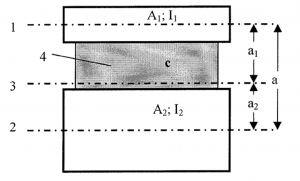

The effective moment of inertia is calculated as follows:
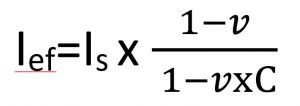
It's here;
Is : Rigid Moment of Inertia
𝓥 : Part of the Moment of Rigid Inertia belonging to the combined system
C: Measure of elastic connection effect
We can find 𝓥 and C values with the following formulas.
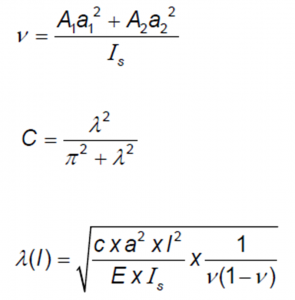
The value of λ depends on the geometry of the profile, the elastic constant c of the heat barrier used, the modulus of elasticity E of the metal (aluminum) and the beam span l. The beam span is the most important variable. At large beam spans, the effective moment of inertia value approaches the value of the rigid moment of inertia.
Let's give an example. We have a profile like the one below.
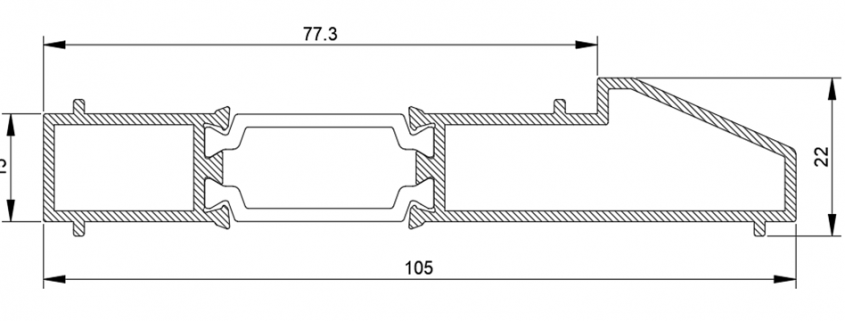
The rigid moment of inertia value of this profile under normal conditions is as follows:
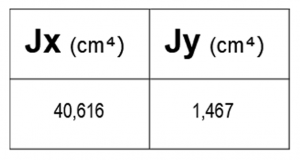
However, when we calculate the Effective Moment of Inertia value according to TS EN 14024 standard, we find the following values according to the length of the profile:
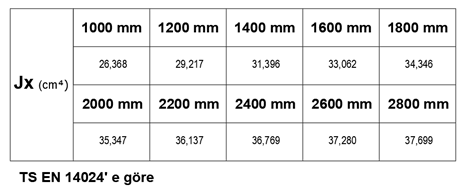
When we look at these values, we can realize how effective the profile length is in the Effective Moment of Inertia.
As a result, we can make the following comments.
-Effective Moment of Inertia calculation is very important in heat barrier profiles. The Effective Moment of Inertia is very close to half the value of the Rigid Moment of Inertia for short beams. In longer lengths, it approaches the Rigid Moment of Inertia. This affects the profile dimensions we determine according to static calculations.
-The quality of the heat barrier used and the way it is applied and attached to the profile are important.